
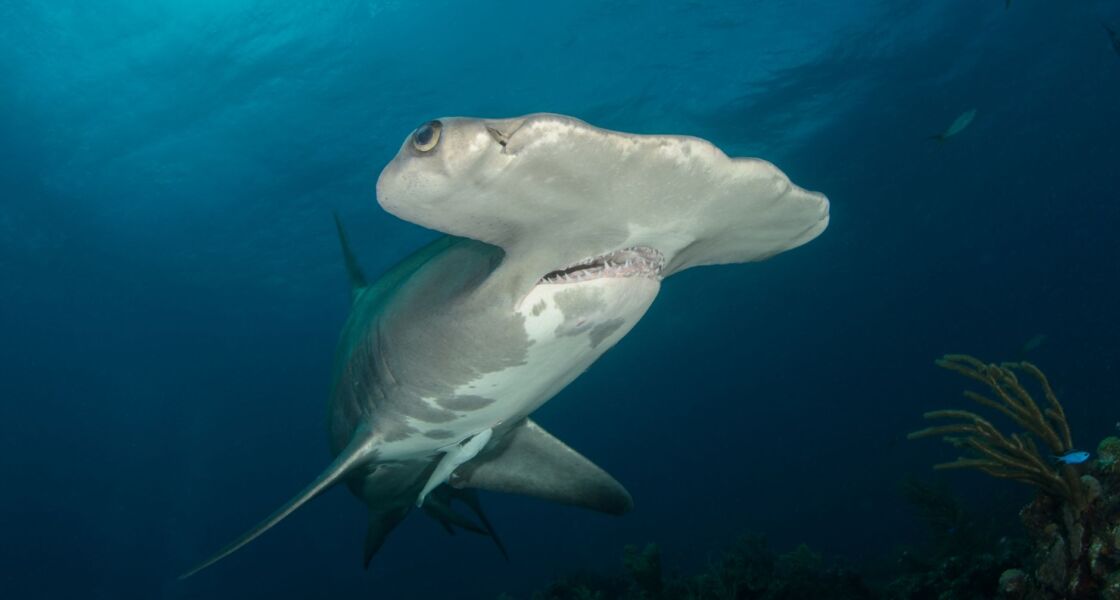
A hammerhead shark has eyes on the two far tips of its head, with a wide, flat bar of skull in between. It looks like a design mistake. It is not, and scientists are still working out exactly why it works.
The wide, flat head has a name: the cephalofoil (SEF-uh-lo-foil). Put simply, it is the “hammer.” Every hammerhead species has one, though the shape differs from species to species.
Why do hammerheads have hammer-shaped heads?
Here is the honest answer: nobody is certain. Researchers have proposed several ideas, and the evidence is still being gathered. A few of the main ones:
A wider view. You might guess that eyes set so far apart cannot work together. A study by Michelle McComb of Florida Atlantic University tested real sharks in tanks and found the opposite. The paper, published in the Journal of Experimental Biology, found that hammerheads have excellent binocular vision, meaning both eyes can look at the same thing at once.
With its head held still and pointed straight ahead, the scalloped hammerhead’s two eyes shared a 34-degree overlap. Two kinds of ordinary, pointy-headed sharks in the same test managed about 10 or 11 degrees. When the scalloped hammerhead swept its head and turned its eyes, the overlap grew to 69 degrees.
A bigger sensing surface. The underside of the head is dotted with tiny jelly-filled pores called ampullae of Lorenzini. They work as sensitive electrical receivers, picking up the faint electric signals that animals give off. In the great hammerhead, the Florida Museum notes, that includes prey buried in sand. A wider head means more room for these sensors, which is one more idea scientists have raised.
Lift and steering. Some researchers have suggested the head works a little like a wing, giving extra lift and turning ability. Science Focus lists this alongside wider eye spacing and more room for smell and electric-field sensors.
Great hammerhead: the big one
The great hammerhead is the giant of the family. It can reach a maximum length of 18 to 20 feet (5.5 to 6 m), and adults average more than 500 pounds (230 kg). The heaviest one on record, caught off Sarasota, Florida, weighed 991 pounds (450 kg).
You can pick it out by its head. It is straight and square, like a bar laid across the front of the body. It lives in warm waters around the world, mostly near coasts, from North Carolina down to Uruguay in the western Atlantic.
It eats a mix of fish, invertebrates, other sharks and rays. Stingrays are its favorite when they are around. Here the sensors may earn their keep. A stingray buried in sand is hidden from view, but it still gives off an electric signal.
Scalloped hammerhead: the one that gathers
The scalloped hammerhead is a bit smaller. NOAA Fisheries says it grows up to about 11 feet (3.4 m) and 335 pounds (152 kg).
This species is the social one. Scalloped hammerheads gather in large groups, and the Florida Museum reports that adults form schools split up by sex. During seasonal migrations, large schools head north for the summer.
Its menu is wide: small schooling fish, reef fish, squid, octopus, crabs and smaller sharks and stingrays. Up to 50 or more stingray spines have been found in the mouths and stomachs of hammerhead sharks, the Florida Museum reports. That is one tough lunch.
A head with a trade-off
No design is perfect. National Geographic reported that the main weak spots in hammerhead vision are large blind spots above and below the head. The same article mentioned anecdotal reports of small fish slipping into those zones.
The head’s electrical sensors are one more tool for finding food, and they work on prey that eyes cannot see.
Where hammerheads stand today
Both species are in trouble. The Florida Museum reports that the IUCN, a global conservation group, lists the scalloped hammerhead as Critically Endangered. The great hammerhead is highly valued for its large fins in the Asian fin trade, the museum adds. In the United States, NOAA Fisheries lists four distinct populations of scalloped hammerheads under the Endangered Species Act: two as endangered and two as threatened.
The main pressures are commercial fishing, including fishing for shark fins, and accidental catch in nets and on lines. Scalloped hammerheads that gather in large groups are especially easy to catch.
For a head that looks like a tool, it holds a lot of mystery. Scientists have good ideas about what it does, and the full story is still open.