
Somewhere in the ocean, a bottlenose dolphin is whistling. It is not just any whistle. It is the one that belongs to that dolphin and no other, a sound that works a bit like a name.
A Name Made of Sound
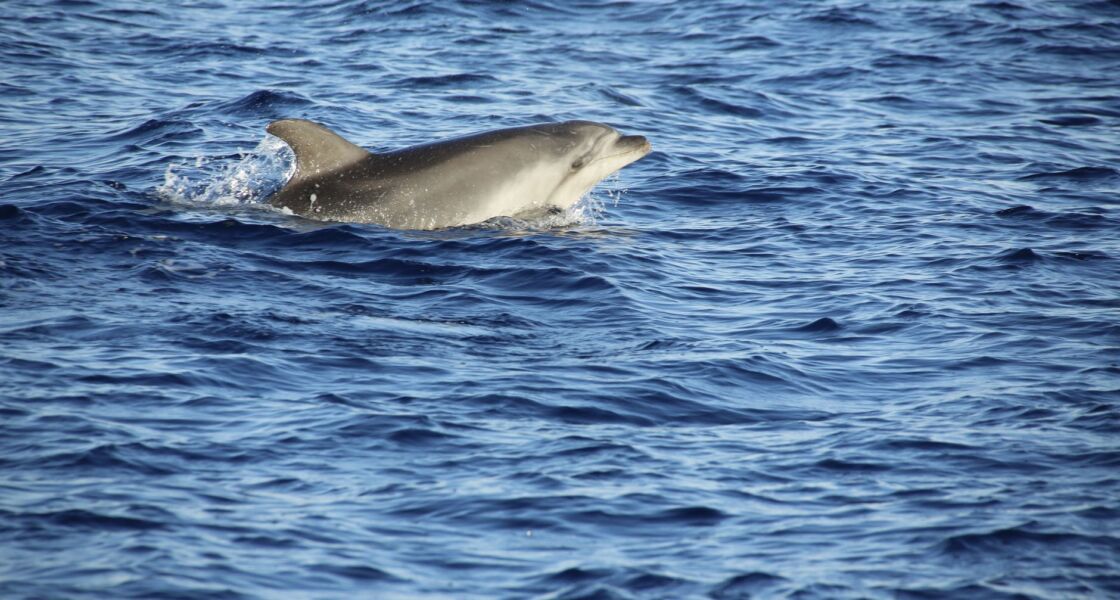
Bottlenose dolphins are gray, sleek swimmers found in oceans around the world. They get their name from their short, thick snout. They also get a signature whistle.
A signature whistle is a learned sound that is different for each dolphin. Researchers who study wild dolphins in Namibia describe it as one that is “learned within the first year of life.” Calves base their whistles on sounds they hear, and most end up with a whistle that differs from those of their closest friends and family.
Once a dolphin has its whistle, the sound pattern stays steady over long periods. Dolphins use these whistles as contact calls, a way to keep a group together and to reunite with familiar dolphins, including mothers and calves. In freely swimming dolphins, signature whistles make up around half of all the whistles they use.
There is a twist. Dolphins sometimes copy the signature whistle of a close companion. Scientists say this may be a way of addressing that dolphin, and they call it unusual in the animal kingdom. Does that make it a name? Researchers describe these whistles as individual labels for different companions, which is about as close as it gets.
Seeing With Sound
Bottlenose dolphins hunt with echolocation, which means making sounds and listening for the echoes.
A dolphin can make up to 1,000 clicking noises per second. The clicks travel through the water until they hit something, then bounce back. The echo tells the dolphin where the target is, and how big it is and what shape it has.
When a dolphin is feeding, that target is often a fish living near the bottom. Dolphins also eat shrimp and squid. NOAA Fisheries says bottlenose dolphins use passive listening, which is simply paying attention to the sounds around them, and high-frequency echolocation to find their meals.
They do not chew, either. A dolphin grips a fish in its teeth and swallows it whole, head first, so the spines do not catch in its throat.
Sleeping With Half a Brain
Here is a puzzle. Dolphins breathe air, so they have to keep coming up to the surface. So how does a dolphin sleep without forgetting to breathe?
It rests one half of its brain at a time. Scientists call this unihemispheric slow-wave sleep. While one side shows the slow waves of sleep, the other side stays in a waking-like state. The bottlenose dolphin is the most studied species in dolphin sleep research. In those studies, an uninterrupted stretch of one-sided sleep lasted from 4 to 132 minutes and averaged about 42 minutes. Dolphins had 2 to 12 of these stretches per day, and the sleeping side tended to switch.
The eyes tell the story. In these studies, the eye connected to the sleeping half of the brain was usually closed or partly closed. The eye connected to the awake half was usually open. Researchers think that open eye may act as a lookout, helping a dolphin keep track of other dolphins and of danger.
A sleeping dolphin does not stop moving. In the studies, dolphins in pools swam slowly, often in circles, or floated at the surface while moving a tail fluke and flippers to stay balanced. Some scientists think at least one half of the brain has to stay active to keep breathing going, though how it works is still not fully known. Mothers and calves keep each other in constant sight, and a calf rests while following its mother.
Fast, Social and Good at Teamwork
In the wild, bottlenose dolphins can reach speeds of more than 18 miles per hour (about 29 km/h). They come up to breathe two or three times a minute.
They travel in social groups called pods. NOAA Fisheries notes that a dolphin may travel alone or with others, and that groups often break apart and then come back together. When dolphins rest, they often bunch tightly, moving slowly and breathing in a steady rhythm.
Teamwork shows up at dinner, too. Dolphins can work together to herd fish into a tight group, then take turns charging through the school to feed. They may also trap fish against sandbars and seawalls.
Family comes first. Calves swim in what scientists call baby position, close beside mom, where nursing is easy and the calf may swim more easily in its mother’s slipstream. Mothers are pregnant for about 12 months and calves nurse for about 20 months. Many stay with their mothers for 3 to 6 years.
National Geographic also reports that schools of dolphins have been known to come to the aid of an injured dolphin and help it to the surface.
A Long Life Near the Coast
Bottlenose dolphins live in warm and mild waters around the world, from harbors, bays and estuaries to the open ocean. Estuaries are the places where rivers meet the sea. In the United States, you can find them along the West Coast, around Hawaii, on the East Coast from Massachusetts to Florida, and across the Gulf of America.
Because many live close to shore, bottlenose dolphins are easy to watch and are among the best-studied marine mammals in the wild.
They can also live a long time. NOAA Fisheries says they can live at least 40 years, and some females live 60 years or more. Females as old as 45 have given birth to calves. National Geographic lists the bottlenose dolphin as Least Concern on the IUCN Red List. That is a lot of years to keep using the same whistle.