

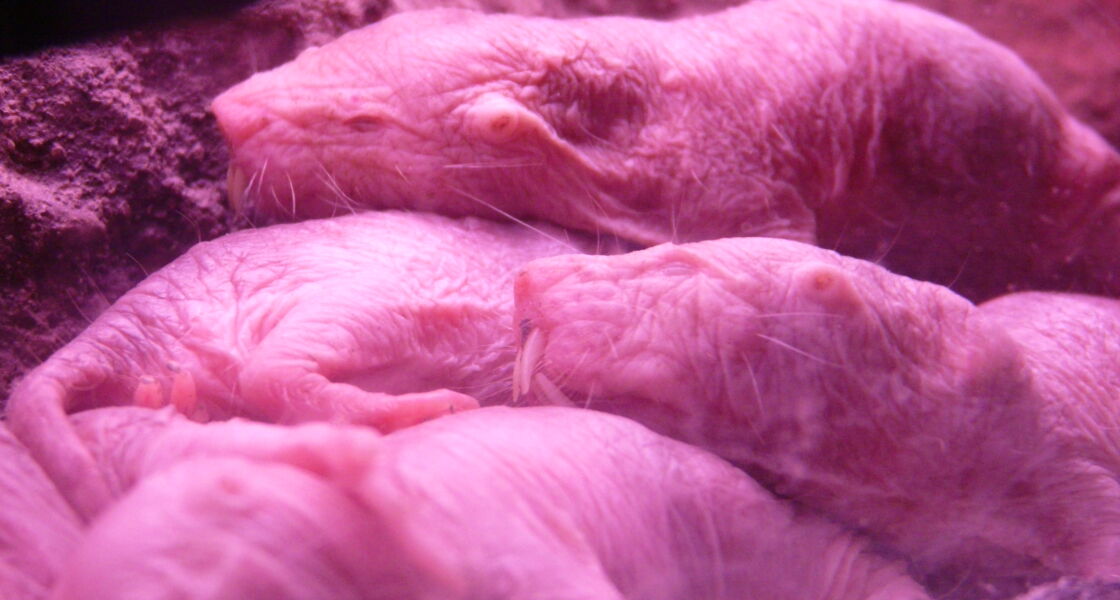
The naked mole-rat is a pink, wrinkly rodent that lives underground in giant family teams. It can live up to 30 years, while a mouse lives only two or three. Wait until you meet the rest of the family.
A Rodent With No Fur and Not Much Sight
Look at a naked mole-rat and the name makes sense. Its skin is wrinkly and pink or grayish-pink, with almost no hair. It is usually about 3 inches (7.5 cm) long and weighs about an ounce.
This animal spends its whole life underground, so it does not need much of what other animals use above ground. It has no external ears, and its eyes are tiny. The National Zoo says that makes it virtually blind.
Instead, it leans on smell. It is also very sensitive to vibrations in the ground and to the movement of air in the tunnels.
Scientists have also looked at the part of the brain that handles touch. Nearly a third of it is devoted to the animal’s four big front teeth. That suggests the mole-rat uses its teeth to sense the world around it.
A Colony With a Queen
Here is the strangest part. Naked mole-rats are rodents, but they live a bit like bees or ants. A colony has one queen, and she is the only female that has babies.
Everyone else is a worker, and workers are both males and females. They dig tunnels, find food, care for the pups and defend the burrows. They could have babies of their own, but they do not while they stay in the colony, which is usually their entire lives.
A typical colony has about 70 members, and the largest one ever observed had 295. Because one queen can rule for many years, workers are mostly raising their little brothers and sisters.
The queen is the biggest animal in the colony. She can weigh up to 2.5 ounces (71 g). Her litters can be huge. The average is about 12 pups, and the largest litter known is about 30, the most of any mammal, according to the National Zoo.
Tunnel Builders With Teeth
Naked mole-rats are expert diggers. Their tunnels are only about 1.5 inches (4 cm) wide, but they branch and connect into a maze. A colony’s tunnels can add up to 2.5 miles (4 km), and some run up to 6.5 feet (2 meters) deep.
The tools are their front teeth, which never stop growing. About a quarter of a mole-rat’s muscle mass is used for closing its jaws. Its lips even close behind the teeth, so it can dig without getting a mouthful of dirt.
They work like an assembly line. The animals at the front break through the soil, and a string of workers sweeps it back along the tunnel. At an opening, one worker kicks the dirt up into the air, and that is how a little mole hill forms.
In the tunnels there are separate rooms for nests and for a toilet. Food is found only by digging, because these animals do not travel above ground.
Snacking on Giant Roots
What does a hairless digger eat? Roots and tubers, which are the thick, juicy underground parts of plants. Some tubers are more than a foot across.
The mole-rats usually bore through one and eat mostly the soft middle, leaving the thin outer skin alone. That may let the plant keep growing, so it keeps feeding the colony for a long time.
Naked mole-rats get all the water they need from their food, so they never drink. They also eat their own droppings now and then, which helps them get more nutrients out of a tough, fibrous diet.
Built for Thin Air
A crowded, poorly ventilated tunnel can fill with carbon dioxide, a gas we breathe out. In the burrows, levels can reach as high as 10 percent, which is lethal to people, National Geographic reports.
The mole-rats cope. Researchers found they can tolerate hours of very low oxygen. In a lab study they survived up to 18 minutes with no oxygen at all.
When that happens, they lose consciousness, and their heart rate slows and breathing stops. When oxygen returns, they start breathing again within moments and go back to normal activity. The study found they burn a plant sugar called fructose for fuel in the meantime.
Long Life, Cold Blood
A University of Rochester team describes the naked mole-rat as the longest-lived rodent, with a life span of up to 30 years. Mice live only about two to three years. Scientists study naked mole-rats to learn more about aging.
They also do something unusual for a mammal. They cannot keep a steady body temperature, so it changes with the temperature around them. To stay warm they huddle together in big piles, or they bask in shallow tunnels that the sun has warmed.
These animals are not in trouble. The National Zoo says there are no immediate major threats, although farmers sometimes see them as pests because they eat the roots of crops such as sweet potatoes.