
Many Arctic foxes change color with the seasons. In winter, the fur turns white. In summer, it turns brown or gray. It is like a wardrobe built to match the ground.
And that is only the start of this small, fluffy animal’s tricks. It lives in some of the coldest places on Earth, including the far north of Alaska.
A coat that follows the seasons
In the Arctic, the ground changes color. Winter brings snow. Summer brings bare tundra, the cold, treeless land of the far north. An Arctic fox changes with it.
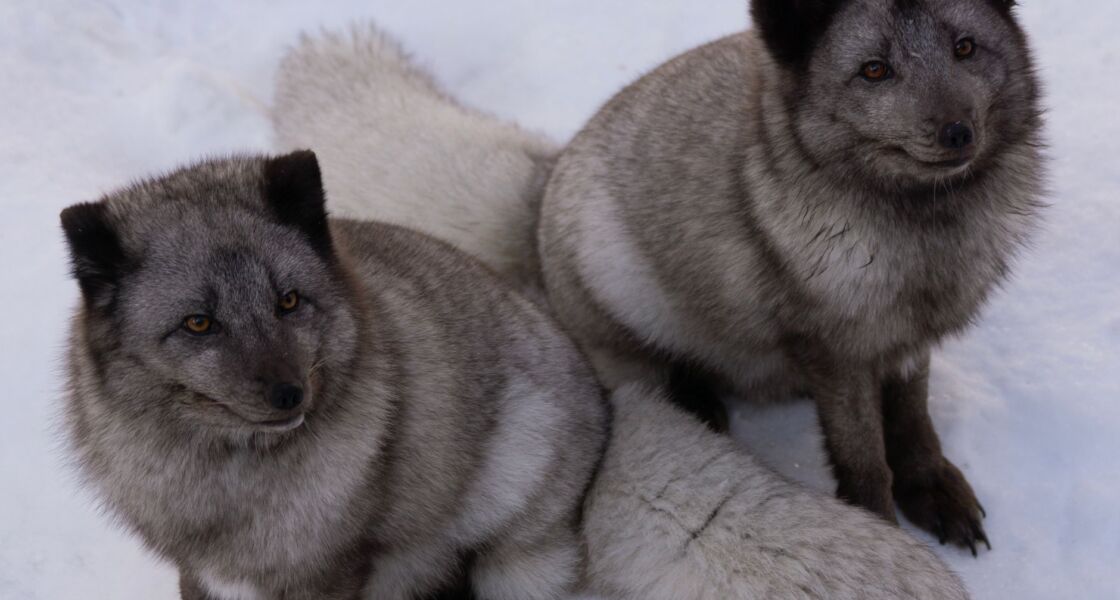
In summer, its fur is mottled black and brown. In winter, it grows a coat that is white. That color helps the fox blend in with the snow, and National Geographic notes that its camouflage helps it hunt.
Not every fox gets the same coat, though. National Geographic says the white winter coat is sometimes blue-gray. In Alaska, the white form is more common in northern populations, while southern ones may have a darker winter coat.
The “blue” fox
A 2009 science column from the University of Alaska Fairbanks describes how this varies from place to place. It says most foxes on the Aleutian and Pribilof Islands do not turn white, but switch to a “blue” phase. On the Pribilof Islands, only a few foxes turn white. On St. Lawrence Island, most change to snow-colored winter coats.
So “blue” is not a different animal. It is still an Arctic fox. How white a fox turns varies from place to place.
One researcher quoted in that report thinks the white coat may help North Slope foxes sneak up on polar bears on the sea ice and grab a snack from a seal kill. Why would a fox go near a polar bear? We will get to that.
How Arctic foxes stay warm
First, meet the fox. Its head and body measure about 18 to 26.75 inches (46 to 68 cm), and its tail can add up to 13.75 inches (35 cm) more. National Geographic lists its weight as 6.5 to 17 pounds (3 to 7.7 kg), while the National Park Service says it can weigh up to 10 pounds.
National Geographic says an Arctic fox can survive temperatures as low as −58°F (−50°C). The fox does it with a few clever features.
National Geographic points to furry soles, short ears and a short muzzle. It calls all three adaptations to the cold.
Then there is the tail. National Geographic says the thick tail works as warm cover in cold weather. It also aids the fox’s balance.
Arctic foxes also use burrows. In a blizzard, one may even tunnel into the snow to make a shelter.
Dinner, wherever it turns up
An Arctic fox is an omnivore, which means it eats both animals and plants. According to the National Park Service, its menu includes small mammals such as voles and lemmings, plus birds, eggs, insects, berries and carrion, which is the leftover meat of animals that have already died.
National Geographic adds that it hunts fish, too, and that it eats plants when it can find them.
Winter is the lean season. The National Park Service says that in fall and winter the foxes prefer treeless coastal areas, where they feed on leftover polar bear scraps. National Geographic says that when prey is scarce, an Arctic fox follows polar bears to eat what they leave behind.
Picture a small fox tagging along behind a polar bear. It is a bold plan. It is also a way to find a meal when little else is around.
Family life underground
In spring and summer, Arctic foxes move to open tundra. That is where they raise their young and hunt small rodents.
Breeding happens in early March and April. About six weeks later, five to eight pups are born in dens six to twelve feet (about 2 to 4 meters) underground, says the National Park Service. National Geographic says litters can be as big as 14 pups.
The pups grow fast. They start eating meat at about four weeks old and are weaned at about six weeks. They leave the den after about three months.
Where to find them
In Alaska, Arctic foxes live along the coast, from the Aleutian Islands north to Utqiagvik and east to the Canadian border. Around the world, they are found in Canada, Greenland, Iceland, Norway, Finland and Russia, plus many Arctic islands.
National Geographic lists the species as Least Concern on the IUCN Red List, the group’s ranking of how at risk wild species are, and gives its population trend as stable. Wild foxes live about three to six years.
For a fox that lives in a snowy world with almost no trees, it has found a lot of ways to make a home there.