
There is a jellyfish smaller than your pinkie nail that has found a way to grow young again. When life gets too hard, it does not simply die. It melts back into an earlier version of itself and starts its whole life over.
Scientists call it the immortal jellyfish, Turritopsis dohrnii. The nickname is a little bold, as you will see, but the trick behind it is completely real.
A jellyfish that hits rewind
Most animals grow up in one direction. A tadpole becomes a frog, and it never turns back into a tadpole. The immortal jellyfish breaks that rule.
Every jellyfish of this kind starts as a tiny blob called a polyp, stuck to the seafloor. The polyp later buds off a free-swimming adult, the bell-shaped medusa you would recognize as a jellyfish. That part is normal. The strange part comes next.
When an adult medusa is hurt, sick, or simply worn out with age, it does something no other animal can do over and over. It shrinks, sinks, and folds back into a little cyst. Within about one to three days, that cyst grows into a brand-new polyp, and the whole life cycle begins again.
It is a bit like a butterfly turning back into a caterpillar. The medusa’s cells quietly switch jobs and rebuild the animal from the earlier stage, a process biologists call transdifferentiation.
Plenty of simple animals can regrow a lost arm or tail. This is different. The whole body resets to an earlier chapter of its life, and then it can do it again. Scientists who study aging keep coming back to this one small jellyfish because almost nothing else in the animal world behaves this way.
So is it really immortal?
Here is the honest answer: not exactly. The immortal jellyfish does not seem to die of old age, and that alone is remarkable. But “does not die of old age” is not the same as “cannot die.”
Out in the ocean, these jellyfish are tiny, soft, and defenseless. Most of them get eaten by a predator or fall sick long before they ever get the chance to rewind. Changes in water temperature, saltiness, or food can finish them off too.
So the better way to say it is this: the immortal jellyfish can escape aging, but it cannot escape being a snack. In a calm lab tank, safe from hungry mouths, it may rewind many times. In the wild, its luck usually runs out.
That is part of why scientists find it so useful. In the quiet of a lab, they can watch the same animal reset over and over, something they can almost never do with the creatures around us.
Smaller than a pencil eraser
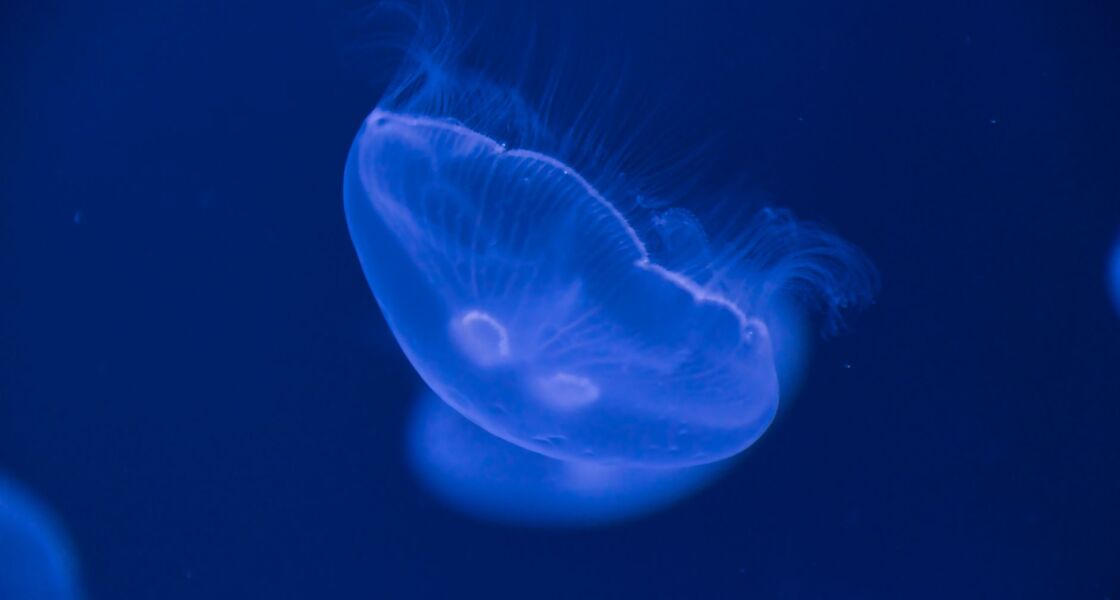
You could easily miss one. A grown medusa is only about a tenth of an inch across, roughly 3 millimeters, smaller than a pencil eraser. Its clear, dome-shaped body has a bright red stomach in the middle and a fringe of fine tentacles, which it uses to catch food.
That food is plankton: the drifting specks of tiny animals, eggs, and shrimp-like creatures that fill the sea. In the lab, scientists feed them newly hatched brine shrimp, the same “sea monkeys” sold in toy stores.
No brain, no heart, and still winning
What makes the whole story even stranger is how simple these animals are. Like other jellyfish, Turritopsis has no brain, no blood, and no heart. It is about 95 percent water, with a body built from just a few thin layers.
Instead of a brain, it has a loose web of nerves called a nerve net. That is enough to sense light, smell the water, and react to the world around it. No thinking required.
Somehow, this see-through scrap of jelly has solved a puzzle that huge, clever animals never could. It does not need a big brain to cheat old age. It just needs the right cells and the ability to start over.
A traveler of the world’s oceans
The immortal jellyfish was first described in the Mediterranean Sea, off the coast of Naples, Italy. Today its relatives turn up in warm and temperate waters around the globe.
How it spread so far is still being studied. Scientists once suspected that jellyfish hitched rides in the ballast water that ships pump in and out, but researchers who looked closely found that this did not fully explain the pattern. For now, part of the journey remains a quiet mystery.
The next time you hear that nothing can live forever, picture a clear dot of jelly drifting in a dark sea, patiently melting back into its own younger self. Not quite immortal, but closer than anything else alive.