
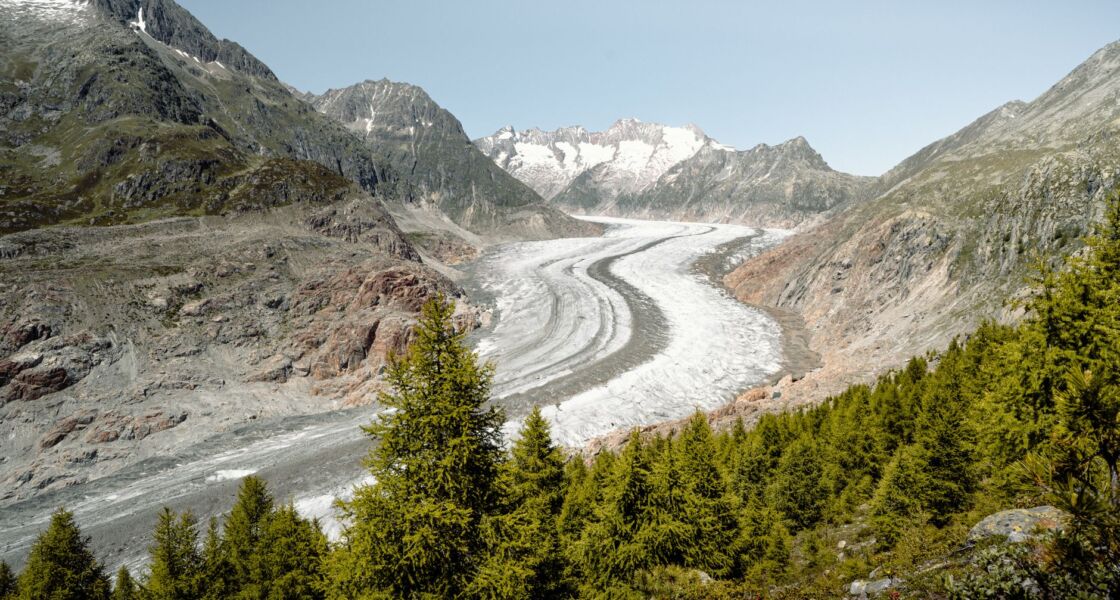
Many glaciers flow so slowly you could stand beside one all day and barely see it move. A glacier is a river made of ice, and it started out as plain snow.
Fresh snow is about 90 percent air, according to NASA. So how does a fluffy pile of flakes turn into a solid ribbon of ice that can wind down a valley? It takes time, weight, and a few steps along the way.
From snowflakes to ice
Every glacier begins with snowfall. When snow builds up, the flakes get packed into grains. The weight of the snow on top presses on the grains below, and those lower grains grow coarser and larger.
The key is where the snow falls. A glacier can form where summer temperatures are too low to melt all of it. In an area with more snowfall than summer melt, patches of snow last through the summer and stay there year after year.
That leftover snow has a name: firn. NASA describes firn as snow that has survived one summer without turning into ice. It is halfway between snow and ice, and it can take about a year to form. In colder parts of the world, it can take as long as 100 years.
Firn does not turn to ice in one step. The National Park Service explains it for the Teton Range in Wyoming. Snow that lasts through summer becomes firn. Firn that sticks around for several years becomes glacial ice.
The change happens when the tiny air passages between the grains are sealed off. NASA says that in glacier ice, air is present only as bubbles. Squeeze those bubbles harder, and the ice gets denser.
The moment it becomes a glacier
Here is the surprising part. A pile of ice does not count as a glacier just because it is big. It has to move.
NASA puts it this way: when the weight of the ice and snow becomes great enough, it begins to flow downhill. When signs of flow appear in a patch of snow that lasts all year, a glacier has begun. The National Park Service says the same thing in different words. If an ice field grows large enough, the ice will flow and slide downhill under its own weight.
Nobody pushes it. Gravity is what moves it.
It sounds impossible. Ice is hard. But glaciers are huge, and all that weight builds up pressure inside.
NASA says glaciers move in two main ways. One is internal deformation, which means the ice slowly changes shape under pressure. The other is sliding at the base, called basal slip. NASA adds that water lubrication is crucial to either process. Under the pressure, the individual ice grains slide past one another, and the whole mass creeps downhill.
Like a river, a glacier moves fastest in the middle. NASA notes that the ice in the center flows faster than the ice along the sides. Over time, the glacier carries rocks along with it. The rock debris flows down the valley with the ice and scrapes at the ground below.
Cracks and speed
If you ever see a glacier up close, you will notice deep cracks called crevasses. A crevasse is a deep, V-shaped crack in the upper layer of ice.
The National Park Service explains why they form. The top layer of ice is brittle, and the ice beneath it is more bendy. When that lower ice flows over bumps or around corners, the top cracks. The park service compares it to bending a candy bar: the brittle chocolate breaks while the caramel and nougat inside bend.
Crevasses open and close as the ice moves, so their pattern keeps changing.
How fast does a glacier flow? It depends on the glacier. The National Park Service says glaciers flow, on average, inches to feet per day.
The small glaciers of Grand Teton National Park sit at the slow end. Studies in the 1960s and 1970s measured Teton Glacier flowing about 30 feet (9 meters) in a year. In summer, that works out to a few inches per day. In winter, the ice freezes to the bedrock, and the flow stops.
Bigger glaciers can really move. In Glacier Bay National Park in Alaska, the National Park Service says Johns Hopkins Glacier can move up to 15 feet (about 4.6 meters) per day. That is the fastest glacier in the park, and you could watch it creep if you stood there long enough with a tape measure.
Where glaciers reach the sea
NASA notes that in cold places with lots of snow, like Alaska, some glaciers flow all the way down to sea level. There they carve fjords. At the glacier’s face, chunks of ice break off and drift away as icebergs. Scientists call this calving.
Glacier Bay National Park alone lists 1,045 glaciers. The longest, Grand Pacific Glacier, stretches 40 miles (64 km).
Every glacier is a balancing act. The National Park Service describes an active glacier as a balance between winter snow and summer melt. If more snow piles up than melts over a number of years, the glacier advances. If melting wins, the front of the glacier pulls back, even as the ice behind it keeps flowing forward.
It is a slow river with a snowy source, an icy middle, and an end that melts away.
Every glacier you can see began as ordinary snow, piled up and left over from one summer to the next.