
The oldest rock Apollo astronauts ever brought home from the Moon is about 4.46 billion years old. The oldest rocks found on Earth are about 4.28 billion years old, the Smithsonian says. The Moon still preserves its earliest history, the first billion years or so.
So what is that ancient world actually made of? Let’s take it apart, layer by layer.
A Rocky Ball With Layers
The Moon is built a lot like Earth. It has a crust on the outside, a mantle in the middle and a core at the center. When it was young and molten, the heavy stuff sank and the light stuff floated, and the layers have stayed put ever since.
The crust is the thin outer shell. NASA says it is about 25 miles (40 km) thick on the side facing Earth and up to about 37 miles (60 km) thick on the far side. Nobody knows exactly why it is lopsided, and scientists are still working on it.
Its ingredients are a list you may know from a rock collection: oxygen, silicon, magnesium, iron, calcium and aluminum. There are also small amounts of titanium, uranium, thorium, potassium and hydrogen.
Under the crust sits the mantle, the Moon’s thickest layer. It is mostly solid rock, though the part nearest the core is partly molten. It is mainly a dark volcanic rock called basalt, rich in two minerals named olivine and pyroxene.
A Small Core
At the very center is the core. It is mostly iron, with a bit of nickel and sulfur. The inside part is solid, and it is wrapped in a layer of molten metal.
Here is the surprise: the Moon’s core is small. It reaches only about 20 percent of the way from the center to the surface. NASA says that is a smaller share than in other well-studied rocky worlds.
That fits with another clue from Apollo rocks. The Smithsonian says the Moon is highly depleted in iron compared with Earth.
The Dust on Top
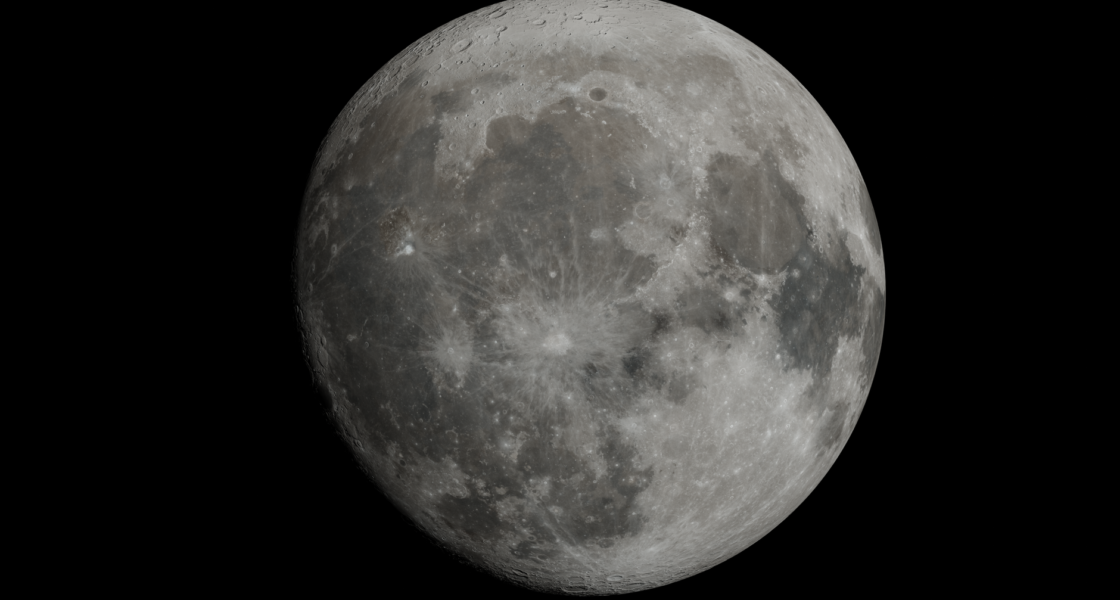
Nearly the whole Moon is covered by a blanket of loose, powdery material called regolith. NASA calls it the Moon’s “soil.” It is a mix of crushed rock, dust and tiny bits of glass, and it looks charcoal gray.
How did it get there? Over billions of years, space rocks big and small have pounded the surface. A Smithsonian article on the Apollo findings says the regolith came from countless impacts over billions of years.
The blanket is not the same depth everywhere. In some young lava plains it is only a few feet deep. In the older highlands it can reach about 66 feet (20 m).
The Sun also leaves something behind. The same Smithsonian article notes that the regolith contains abundant hydrogen implanted by the Sun.
842 Pounds of Moon
We know all this partly because we have touched the Moon and carried pieces home. Between 1969 and 1972, six Apollo missions brought back 842 pounds (382 kg) of lunar rocks, core samples, pebbles, sand and dust. That was about 2,200 separate samples from six different places.
The Smithsonian says the rocks include basalts and anorthosites, along with a third kind called breccias. Basalts are dark lava rocks that fill the Moon’s big basins. That record-setting 4.46-billion-year-old rock, found by the Apollo 16 astronauts, is an anorthosite. The Smithsonian estimates its age, so treat the number as a careful scientific estimate.
The rocks live at NASA’s Johnson Space Center in Houston, and scientists are still studying them. NASA sends out nearly 400 samples every year for research and teaching.
The rocks also hold a plot twist about water. The Smithsonian says all Moon rocks formed through high-temperature processes with little or no involvement with water. Yet there is water on the Moon, and that is the next part of the story.
Ice in the Dark
Some craters near the Moon’s poles have floors that never see sunlight. NASA calls these lightless places permanently shadowed regions. The idea, popularized in 1961, was that ice could collect there and stay frozen.
That turns out to be a good guess. NASA reports that a mission called LCROSS and the Lunar Reconnaissance Orbiter found grains of water ice in material thrown out of a crater. In 2018, data from an instrument called the Moon Mineralogy Mapper confirmed several places with water ice in shadowed regions.
Sunny spots are another matter. In sunlight, NASA says, water would evaporate almost instantly. Even so, an airborne telescope named SOFIA found water in the sunlit Clavius crater, stuck to or inside bits of lunar dust. NASA says that works out to about a 12-ounce bottle of water in a cubic meter of soil. That is a box of dirt roughly three feet on each side.
Where the Moon Came From
If the Moon is a lot like Earth’s crust and mantle, maybe that is no accident. NASA says the Moon is thought to have formed in a tremendous collision near the time the solar system formed, about 4.5 billion years ago. The object that hit Earth was perhaps a single one about the size of Mars. Debris from the crash gathered together and became the Moon.
Apollo rocks back this up. They showed the Moon had been molten when it formed. Their oxygen atoms also matched Earth rocks so precisely that NASA says it could not be a coincidence. Scientists still debate some details, but almost all of the competing ideas share that big impact.
So the answer to “what is the Moon made of?” is a short one. It is made of layered rock with a makeup a lot like Earth’s, wrapped in impact dust and holding a little ice in the dark. Not bad for a ball of gray stone.