
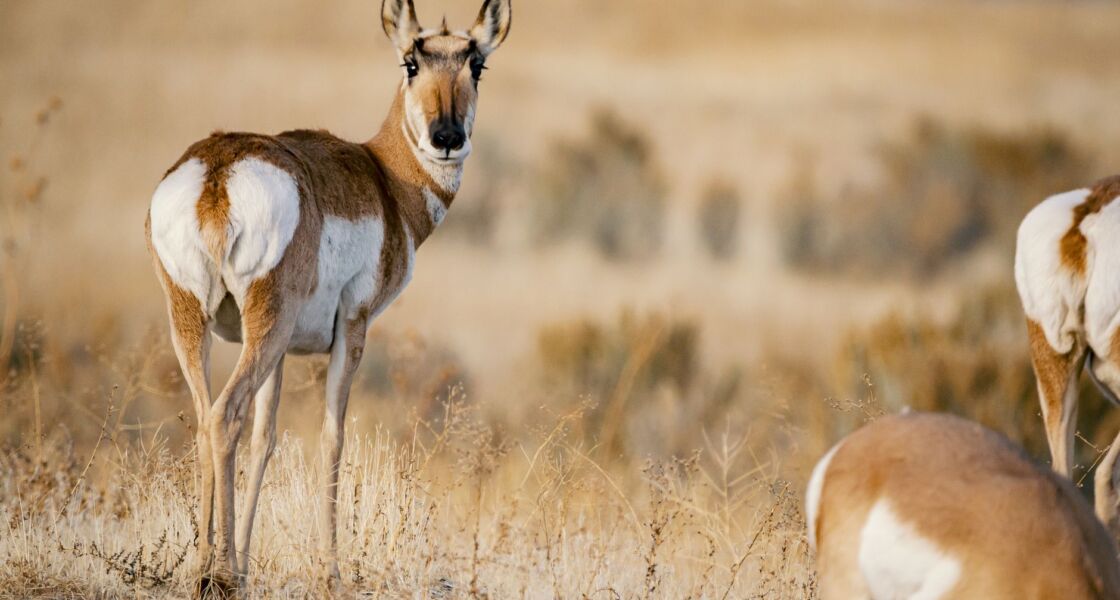
Picture a deer-sized animal sprinting across open prairie at about the speed limit on a country highway. That is the pronghorn, the fastest land animal in North America. Here is the odd part: nothing alive today can catch it, and it has been running from something that vanished thousands of years ago.
Not a Deer, Not an Antelope
Pronghorns look a bit like deer and get called “antelope,” but they are neither. A true antelope lives in Africa or Asia. The pronghorn lives only in North America, on open plains and sagebrush country in the West.
The name “antelope” goes back to the Lewis and Clark Expedition. In 1804, the explorers saw a creature they had never seen before. One wrote that it had legs like a deer, feet like a goat and horns like a goat, “only forked.” They tried several names before Captain Lewis settled on “antelope.”
Today the pronghorn stands alone. It is the only surviving member of its family, Antilocapridae. Its closest living relatives are the giraffe and the okapi.
Built for Speed
An adult pronghorn weighs roughly 90 to 125 pounds and stands about 3 feet tall at the shoulder. It has long, slim legs, a light body and cushioned hooves.
Inside, it is built even more for the chase. Its windpipe is oversized. So are its heart and its lungs. That lets a huge amount of oxygen reach its muscles.
The results are impressive. Pronghorns have been clocked at about 45 to 55 miles an hour in sustained sprints. National Park Service writers note that one can hold about 55 mph for half a mile, then keep going at around 45 mph for much longer. At full speed, a single stride can cover up to 24 feet. That is longer than most cars.
Only the cheetah is faster on land. Its sprint is shorter, though, and the pronghorn is built to keep going.
Running From a Ghost
Here is the mystery. No predator on today’s prairies comes anywhere near the pronghorn’s speed. Coyotes and bobcats can’t keep up. So why would evolution build such a racer?
Scientists think the answer is the American cheetah. It was a fast ambush hunter that lived in North America until roughly 12,000 years ago. The cheetah is gone, but the pronghorn kept the speed.
The pronghorn’s family tree goes deep. Its group evolved in North America over about the past 20 million years, and the pronghorn is the last one left.
Eyes Like Binoculars
Speed is only half the plan. The other half is spotting trouble early.
A pronghorn’s big, dark eyes sit on the sides of its head. The National Park Service estimates they give it about 320 degrees of vision. It can notice a moving object about 3 miles away. That is why pronghorns like wide-open spaces, where nothing can sneak up on them.
When one animal sees danger, it flares the white hairs on its rump. The bright patch flashes a warning to the rest of the herd, and everyone bolts.
Horns That Fork
Both males and females have horns, but they look very different. A male’s horns are pronged, with a forward-pointing fork that gives the animal its name. They are typically 10 to 16 inches long and can reach 18. A female’s horns are much smaller, often just short spikes. Some females have none at all.
Males also have black patches on the face. That makes them easier to tell from females.
Babies That Outrun You
Pronghorn fawns arrive in late spring, and twins are common. A newborn weighs only about 5 to 9 pounds. It can walk within 30 minutes. In a couple of days, it can outrun a person.
For the first weeks, fawns stay hidden in the grass and lie perfectly still. The mother grazes nearby and checks in only briefly each day. Park staff say that if you spot a lone fawn, it is most likely waiting for its mom, not abandoned.
Autumn Showdowns
Pronghorns breed in the fall. Bucks gather groups of females and defend them. They warn rivals with loud snorts and wheezing coughs. If that fails, two bucks press their horns together, then twist and shove until the weaker one backs off. It looks rough, but deaths are rare.
What’s on the Menu
Pronghorns are plant eaters. They munch sagebrush and other shrubs, leafy wildflowers called forbs, and some grasses. Sagebrush is especially important in winter.
They can even eat some plants that are poisonous to some other grazers. Yellowstone biologists think the pronghorn’s large liver may help clear those toxins from its blood.
Fences Are the Real Problem
Pronghorns can run for miles, but they rarely jump. If a fence is in the way, they would rather squeeze under it than hop over.
There were once an estimated 35 million of them before settlement of the American West. Settlement and hunting cut their range and numbers. National Geographic reports the species as Least Concern, with a stable population overall. If you travel through the West, keep an eye on the open grassland. A flash of white rump might be a pronghorn.