
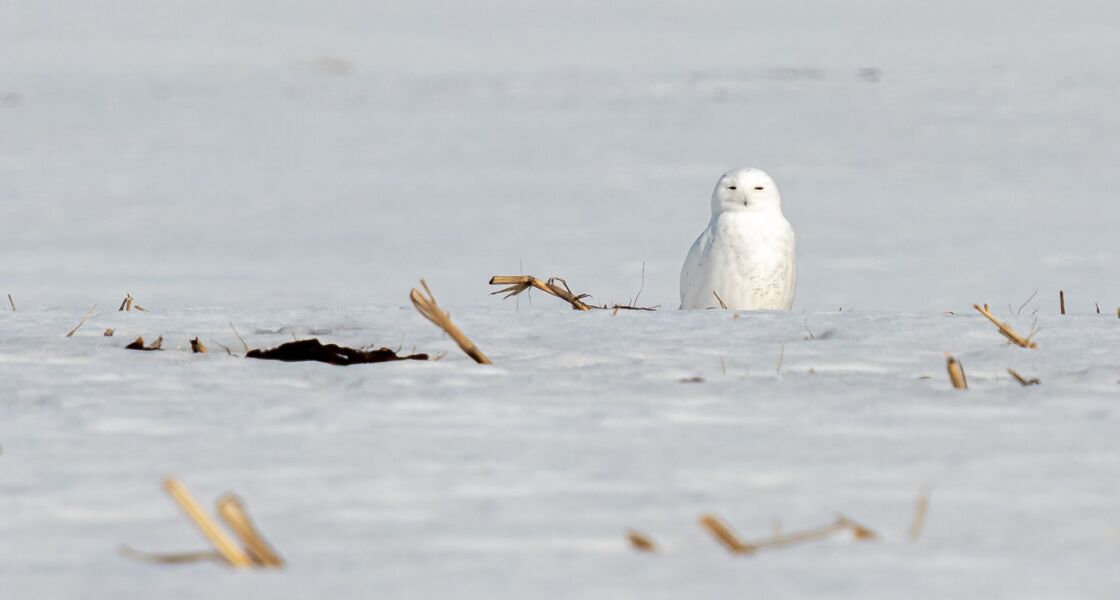
Most owls hunt in the dark. The snowy owl often hunts in broad daylight, watching from a perch, white as a snowdrift, until something small and furry makes a mistake.
It lives most of the year on the Arctic tundra. But in some winters, snowy owls turn up in places where almost nobody expects them: farm fields in Ohio, beaches on the Great Lakes, even the edges of big airports.
Built like a snowdrift
A snowy owl is a big bird. It measures 20 to 28 inches (51 to 71 cm) long, with a wingspan of 4.2 to 4.8 feet (1.3 to 1.5 m). It weighs about 3.5 to 6.5 pounds (1.6 to 2.9 kg). With its bulky body and dense feathers, it is the heaviest owl in North America.
The white plumage is the famous part, but not every snowy owl is equally white. Females are darker, with dusky spots, and they never turn fully white. Young males get whiter as they age. Some old males are almost pure white.
Even the legs and feet are covered in thick feathers, a built-in pair of winter boots for extreme cold.
An owl on the day shift
Snowy owls are diurnal, which means active during the day. Their usual style is patient. An owl perches, watches, spots a meal, and then swoops off in swift pursuit.
They can sit motionless for hours, and against snow they are hard to see. Keen eyesight and great hearing help them find prey hidden under thick vegetation or snow.
The favorite meal is the lemming, a small, round-bodied Arctic rodent. Snowy owls also eat rabbits, other rodents, birds and fish.
Nesting on open tundra
Snowy owls breed on the Arctic tundra, in wide-open country from just north of the treeline to the northernmost land. Unlike most owls, they nest on the ground.
Lemmings decide how big the family gets. A female lays 3 to 11 eggs, depending on how much food is around. In lean years, a pair may skip nesting altogether. The female sits on the eggs alone for about 31 to 33 days.
In a good lemming year, a nest can be crowded. In one lemming boom in northern Quebec, nests held six to eight chicks, when one to three is more normal. The chicks may leave the nest after two or three weeks, but they cannot fly well until they are about 7 weeks old.
Parents are fierce about it. Snowy owls vigorously defend their territory, and some have even been recorded attacking Arctic wolves.
Why do snowy owls come south?
For years, the usual explanation was hunger: the lemmings crash, so the owls head south to find food. Scientists now say it is closer to the opposite.
The big southern surges, called irruptions (a sudden flood of birds far outside their usual range), come after Arctic baby booms. When lemmings are plentiful, lots of chicks are raised. That fall, a crowd of young owls spreads out. According to Audubon, these winter arrivals are “not a response to food shortages, but a result of owl baby booms fueled by bountiful prey in the form of lemmings.”
Most of the owls in an irruption are healthy young birds born the previous summer. One idea is that older, more dominant owls hold the best Arctic spots, so young birds go looking for a place to spend their first winter. Smaller surges happen about every four years, tied to the lemming cycle.
Not every owl travels. Some stay in the far north all year, and some tagged owls spent the winter far north, on what looked like pack ice. Others went south, with one traveling more than 2,000 miles.
Where they land in the US
Snowy owls look for places that feel like tundra: wide, open and flat. In winter, they use prairies, farmland, coastal marshes, beaches and large airports. Birds have shown up around the Great Lakes, particularly Ontario, Michigan and Wisconsin, and in states such as Ohio, New York and Colorado.
Scientists follow some of these travelers. Project SNOWstorm, formed after the 2013–2014 irruption, has tracked more than 115 owls across 17 states and provinces with solar-powered transmitters.
A bird with a lot of ground to cover
Audubon lists the snowy owl as Vulnerable on the IUCN scale (the international Red List that tracks the status of wildlife). National Geographic says its population is decreasing. Audubon notes that snowy owls were formerly shot during their winter trips south.
So the next time you see a white shape out in a winter field, look twice. It may be a young owl that grew up above the Arctic Circle and flew a long way to sit on your local fence post.