
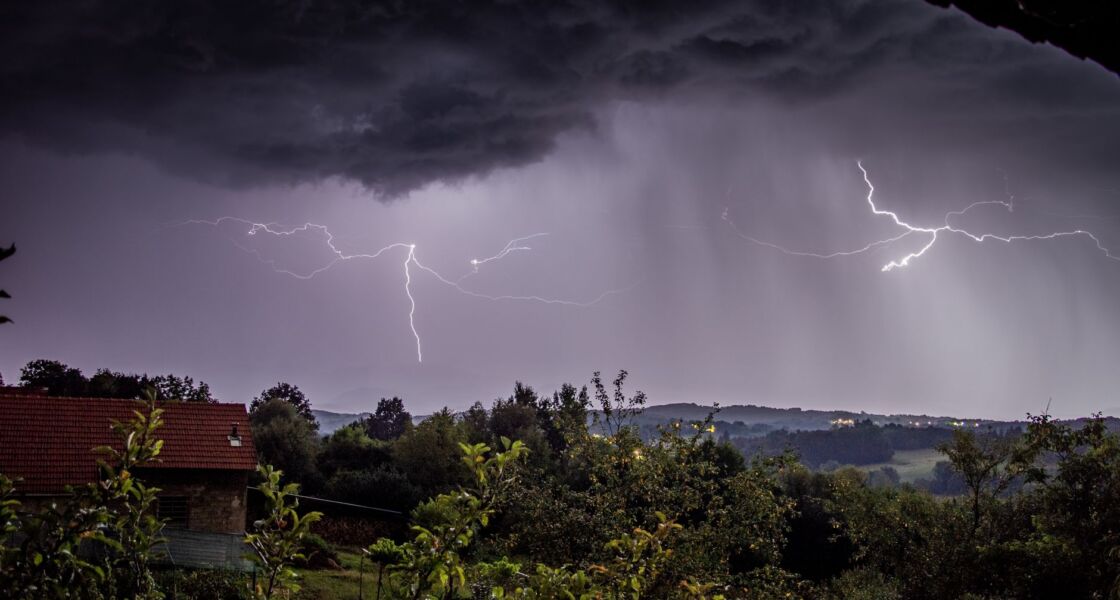
Thunder is not one sound. It is millions of tiny booms, all arriving at your ear in a line.
That is why a nearby strike goes crack and a far-off one goes rrrumble. The same lightning bolt makes both sounds. The only difference is where you are standing.
A boom made of air
Start with the flash. A lightning bolt can heat the air around its path to about 54,000°F (30,000°C).
The air does not get that hot slowly. It happens in a tiny fraction of a second. Hot air wants to expand, and when it is heated that fast, it expands in a rush. It shoves the air in front of it so hard that it forms a shock wave, similar to a sonic boom.
So thunder is not a noise that the lightning “gives off.” It is the sound of air being pushed out of the way, very fast, by a channel of heat.
A bolt is long, and sound is slow
Here is where the rumble comes from. A lightning bolt is not a single point. It is a long, jagged path, and the shock wave is made at every spot along it. NOAA, the US weather and ocean agency, says the combination of millions of shock waves gives thunder the continuous rumbling sound we hear.
Light is so fast that you see the whole bolt at once. Sound is much slower. It travels about one mile every five seconds. So the boom from the closest part of the bolt reaches you first. The boom from the farther parts of the path comes after, then the next, then the next.
Picture a long line of drummers, each one starting at the same moment. If you stand at the front of the line, you hear the nearest drum first and the farthest one last. The sound smears out into one long roll. A bolt works the same way.
Why close thunder cracks
When lightning is very close, the sound hits you almost at once. NOAA says the first sound reaches your ear as a loud bang, crack or snap. The shock wave is still sharp, because it has not yet been stretched out on the way.
Shock waves also change on the way. As they spread away from the bolt, they get stretched out and distorted, and the sound grows more muted. At a great distance, NOAA says, thunder is greatly elongated and can be many miles across. By then the sharp crack has turned into a low, steady growl.
The path of the bolt matters, too. NOAA explains that booms from different places along it can reach your ear at the same moment, and when they do, they add up and make the sound more intense.
How far can you hear it?
Not very far, for something so loud. Air gets cooler as you go up, and in that normal setup thunder can usually be heard up to about 10 miles (16 km) away.
Sometimes the air does the opposite. When a layer of warm air sits above cooler air near the ground, sound waves bend back toward Earth. NOAA says this can add extra sound and make thunder louder. It is more common in winter, when storms form in warm air above a cooler layer of air at the surface.
If you can hear thunder at all, National Geographic notes, you are within about 10 miles of the storm. That matters because lightning can reach out that far. UCAR describes a “bolt from the blue,” a flash that starts inside a cloud, travels sideways, and then strikes the ground up to 6 miles (10 km) from the storm, where the sky overhead can still look clear. The rumble is a sign that a storm is near, even when it does not look it.
Here is a detail that surprises people. The flash and the thunder happen at roughly the same time. You just see one before you hear the other, because light travels much faster than sound. The sound is running a race it can never win.
Which brings us to a handy trick. Light arrives first, thunder second, so the gap tells you how far away the bolt was. Count the seconds between the flash and the first rumble, then divide by five. The answer is the distance in miles. A 15-second gap means the lightning is about 3 miles (5 km) away.
The speed of sound is not fixed, either. NOAA notes that sound waves move faster in warm air than in cool air. That is why “five seconds per mile” is a good rule of thumb, not an exact measurement.
The silent flashes
Ever seen a flicker of lightning on a warm night, with no sound at all? People call it heat lightning. According to the University Corporation for Atmospheric Research (UCAR), it is just cloud-to-cloud lightning from a storm so far off that the thunder never reaches you. You can sometimes see the light from beyond the horizon. The sound simply fades out first.
UCAR also says that most lightning during a thunderstorm is cloud-to-cloud, not cloud-to-ground. There are 10 to 15 times more cloud-to-cloud flashes than flashes that reach the ground.
So the next time a storm rolls in, try this. Listen for the first sharp crack, then the long roll that follows. You are hearing the shape of the bolt, laid out in time.