
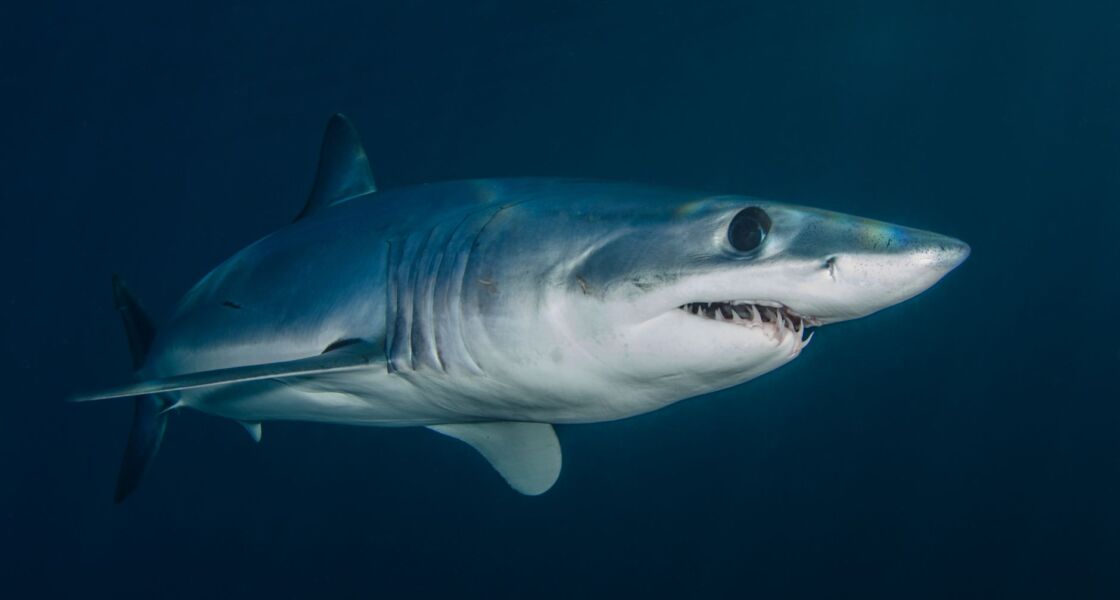
The shortfin mako is called the fastest shark in the world. Here is the fun part: nobody agrees on exactly how fast that is. One source says 43 miles per hour. Another says up to 90.
So How Fast Is It?
The Florida Museum of Natural History says the mako can reach burst speeds of up to 43 mph (70 km/h). Oceana, an ocean conservation group, also gives 43 mph. NOAA Fisheries, the US government’s ocean agency, says a shortfin mako can have swim bursts up to 90 mph.
That is quite a gap, and the sources do not explain it. The safer number is the lower one. A “burst” means a short, all-out sprint, not a speed it keeps up all day.
Even at the low end, 43 mph is faster than a car on many city streets. Whichever number you pick, the mako is built for speed.
A Body Shaped Like a Torpedo
Look at a mako and you can see it. The body is long and round, and the snout is pointed. The Florida Museum calls the shape “markedly hydrodynamic,” which means water slips around it with very little drag.
The tail is the engine. It is crescent-shaped, tall and narrow, and it gives the shark almost all of its push. The scientific name even points to it. Isurus is Greek for “equal tail,” because the top and bottom lobes are about the same size.
The color helps too, in a different way. A mako is deep metallic blue on top and white underneath, with a sharp line between the two. From above it blends into the dark water. From below it blends into the bright surface.
Engineers noticed. NOAA says shark denticles have long inspired people who design things to cut drag in air and water, from swimsuits to airplane wings.
Young makos have one more look of their own. A juvenile has a dark blotch on the tip of its snout. Bigger, older sharks tend to be darker overall.
A Fast Fish With a Warm Body
Most fish are the same temperature as the water around them. The mako is different. Special tangles of blood vessels, called countercurrent exchanges, let it keep its body warmer than the sea, according to Oceana. The same trick is used by great white sharks.
That matters for a sprinter. Warm muscles work better, so the mako can keep hunting in cooler water and still swim fast.
Built to Chase Swordfish
The mako needs all that speed for dinner. It hunts other fast ocean fish, such as swordfish and tuna, plus squid and sometimes other sharks. Sea turtles and marine mammals are on the menu now and then.
Its teeth are long, narrow and hook-like. In bigger sharks they often stick out of the mouth even when it is closed.
The mako is also known for leaping. It often breaches, or jumps clear of the water, when it feeds. Oceana says it can leap to extreme heights.
The Florida Museum even shows a photo of mako bite marks on a swordfish. Proof that the chase sometimes ends in the mako’s favor.
Slow to Grow Up
For a shark that moves so fast, the mako takes its time with life. Males are ready to have young at about 7 to 9 years old. Females wait until at least 18. A mother carries her young for 15 to 18 months, and a litter is 4 to 25 pups.
The pups are not tiny. Each one is already about 23 to 28 inches (60 to 70 cm) long at birth. Before that, the babies grow inside their mother and eat unfertilized eggs. Scientists call it oophagy.
Makos are estimated to live about 29 to 32 years. Adults are fairly big, with males averaging about 6.5 to 7 feet and females about 9 to 9.5 feet. The largest can reach around 13 feet (4 m).
Danger from other animals is low for adults. The Florida Museum says larger sharks may eat young makos, but a full-grown mako likely has only one real predator: people.
All that waiting to grow up has a side effect. The Florida Museum says slow growth and a three-year breeding cycle make makos vulnerable to overfishing. It also says counting them worldwide is hard, because they travel so far.
Where Makos Roam
Shortfin makos live in warm and mild waters all over the world. In North America they range from California south to Chile in the Pacific, and from Canada’s Grand Banks down to Argentina in the Atlantic, including the Gulf of Mexico.
They are mostly open-ocean wanderers. They are usually found in water warmer than about 60°F (16°C), from the surface down to roughly 1,640 feet (500 m).
The name “mako” comes from a Maori word that means “shark.” Since July 2022, the National Marine Fisheries Service has banned keeping this species in the US Atlantic, according to Oceana.